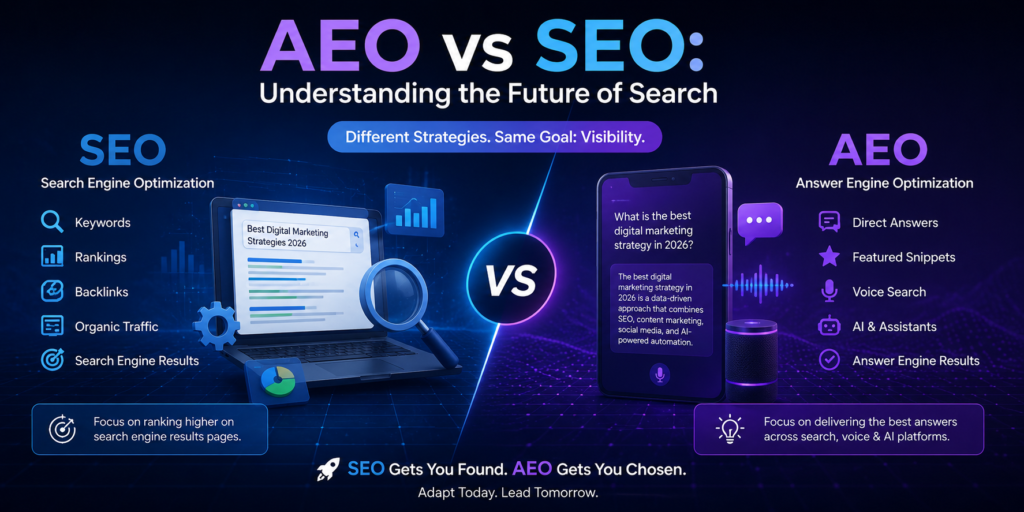
Search is evolving rapidly. For years, Search Engine Optimization (SEO) has been the foundation of digital marketing, helping businesses rank higher on search engines like Google and attract organic traffic. However, the rise of artificial intelligence, voice assistants, and AI-powered search platforms has introduced a new concept: Answer Engine Optimization (AEO).
As users increasingly expect direct, accurate answers instead of browsing through multiple web pages, businesses need to understand the differences between SEO and AEO. While SEO focuses on improving visibility in search results, AEO aims to position content as the best answer for AI-powered search experiences. In 2026, a successful digital marketing strategy requires both.
What is SEO?
Search Engine Optimization (SEO) is the practice of optimizing websites to improve their visibility on traditional search engines. The goal is to rank higher for relevant keywords, attract organic traffic, and increase conversions.
SEO involves several strategies, including:
- Keyword research
- High-quality content creation
- On-page optimization
- Technical SEO
- Link building
- Mobile optimization
- Page speed improvements
For example, if someone searches for “best digital marketing agency,” SEO helps your website appear among the top search results.
What is AEO?
Answer Engine Optimization (AEO) focuses on optimizing content so AI-powered search engines, voice assistants, and generative AI platforms can understand and present it as a direct answer to users’ questions.
Instead of simply ranking a webpage, AEO helps your content become:
- Featured snippets
- AI-generated answers
- Voice search responses
- Knowledge panels
- AI assistant recommendations
For example, when someone asks,
“What is the best SEO strategy in 2026?”
An AI assistant may provide a summarized answer directly instead of displaying a list of websites. If your content is optimized for AEO, your website has a better chance of being the source of that answer.
SEO vs AEO: Key Differences
| SEO | AEO |
|---|---|
| Focuses on ranking webpages | Focuses on providing direct answers |
| Targets search engines | Targets AI search engines and assistants |
| Relies heavily on keywords | Prioritizes user intent and natural language |
| Optimizes for clicks | Optimizes for answer visibility |
| Measures rankings and traffic | Measures citations, visibility, and AI mentions |
| Best for traditional search | Best for conversational and AI search |
Why AEO Matters in 2026
The way people search online has changed dramatically. Instead of typing short keywords, users now ask complete questions through voice assistants and AI chatbots.
Examples include:
- “What’s the best CRM for small businesses?”
- “How do I improve my website’s SEO?”
- “Which digital marketing strategy delivers the highest ROI?”
Modern search engines increasingly provide direct answers, reducing the need for users to click multiple links. Businesses that optimize for AEO are more likely to be featured in these AI-generated responses.
How AI is Changing Search
Artificial intelligence has transformed how search engines understand content. Rather than matching exact keywords, AI analyzes context, intent, semantics, and user behavior.
Today’s search platforms prioritize content that is:
- Accurate
- Helpful
- Well-structured
- Trustworthy
- Easy to understand
- Updated regularly
This shift means marketers should focus on creating content that genuinely answers users’ questions rather than simply targeting keywords.
Best Practices for SEO
To maintain strong search rankings:
- Conduct thorough keyword research.
- Write valuable, in-depth content.
- Optimize titles and meta descriptions.
- Improve website speed.
- Ensure mobile responsiveness.
- Build high-quality backlinks.
- Use proper heading structures.
- Optimize images and internal links.
These fundamentals remain essential for driving long-term organic traffic.
Best Practices for AEO
To optimize content for answer engines:
- Answer questions clearly and concisely.
- Use conversational language.
- Structure content with headings and bullet points.
- Include FAQ sections.
- Implement structured data (Schema Markup).
- Demonstrate expertise with credible sources.
- Keep information current and accurate.
- Focus on search intent rather than keyword repetition.
These practices make it easier for AI systems to understand and surface your content.
Can SEO and AEO Work Together?
Absolutely. SEO and AEO are not competing strategies—they complement each other.
SEO helps users discover your website through search results, while AEO increases the likelihood that your content will be selected as the best answer by AI-powered search platforms.
Businesses that combine both approaches benefit from greater visibility, stronger authority, and improved user engagement.
The Future of Search
Search is becoming more conversational, personalized, and AI-driven. Voice search, generative AI, and intelligent assistants are changing how users find information.
To stay competitive, businesses should:
- Continue investing in strong SEO foundations.
- Optimize content for AI-generated answers.
- Publish authoritative, trustworthy content.
- Focus on user experience and intent.
- Regularly update existing content.
The future belongs to brands that provide valuable information in formats both humans and AI can easily understand.
Conclusion
SEO remains essential for driving organic traffic, but Answer Engine Optimization is quickly becoming a critical part of modern digital marketing. As AI-powered search continues to grow, businesses must adapt by creating high-quality, structured, and user-focused content.
Rather than choosing between SEO and AEO, the most effective strategy is to integrate both. By combining traditional search optimization with AI-ready content, businesses can increase their visibility across search engines, voice assistants, and AI platforms, ensuring they remain competitive in the future of search